Project map
The BDA project, from first survey to yearly test
A BDA job passes through five hands before it is done: yours, a radio tester, a designer, the agency that owns the radio channels, and the fire department. This map shows what you hand over and get back at each stage, so nothing stalls on a missing letter or a locked door.
Who touches the job
| Stage | You hand over | You get back | Who else is involved | Published timing |
|---|---|---|---|---|
| 1. Confirm the requirement | Building facts, any notice | A written yes, no or "test it" with a citation | Fire marshal (AHJ) | None, except a Florida retrofit order: at least 1 year from the notice (F.S. 633.202(18)(g)) |
| 2. Survey the building | Floor plans, keys, an escort | A grid survey report for every floor | Radio tester; in Miami-Dade, MDFR's pre-test | Miami-Dade: results within two business days (MDFR guidelines) |
| 3. Design and sign-offs | The survey, the fire department's radio criteria | Approved plans, licensee consent, permit, FCC booster ID | Designer, radio licensee, fire department, FCC | Not published |
| 4. Install and acceptance | Access for the install crew and the inspector | Acceptance report with gain values, closed permit | Installer, power and pathway contractor, fire department | Not published |
| 5. The yearly cycle | Access on test day, the last report | A new annual report sent to the fire department | Tester, fire department, service contractor | Yearly, and after structural changes (IFC 510.6.1) |
"Not published" means no code or fire department document we have read sets a time. Put the vendor's schedule in the contract.
Stage 1: Confirm the requirement
The fire code calls for approved emergency responder radio coverage inside buildings (IFC 510.1), and in Florida the requirement is also state law, with listed exemptions (F.S. 633.202(18)(h)). Only the fire marshal can tell you how the rule applies to your building, so ask in writing and keep the answer.
- Paper you keep: the fire marshal's letter or notice, with the code section.
- What trips buildings up: acting on a vendor's word instead of the fire department's. For the rules where you are, ERRCSCheck's building checker applies the published exemptions and links each local requirements page.
Stage 2: Survey the building
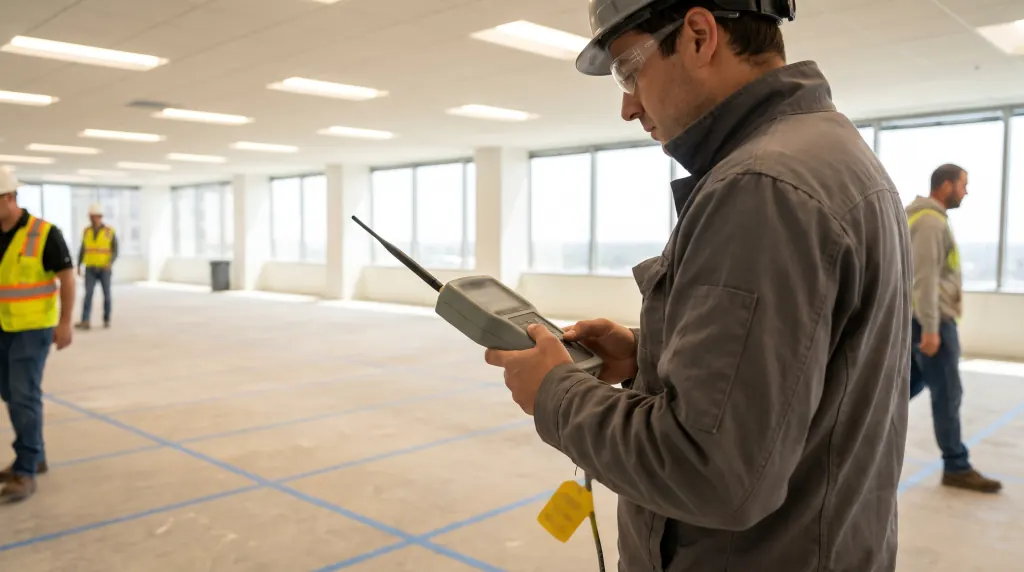
A radio tester walks each floor in a grid and records the signal (IFC 510.5.4). Miami-Dade runs its own pre-test (Phase I) with a calibrated spectrum analyzer and handheld voice tests before a building may apply for a BDA permit (MDFR guidelines). If the survey passes, no amplifier is needed (IFC 510.4.2.1).
- Paper you keep: the survey report and grid maps, one per radio band where the fire department uses more than one (Miami-Dade tests 450 MHz and 800 MHz separately).
- What trips buildings up: rooms nobody can open on the day, and a survey on the wrong frequencies. The fire department's technical criteria list the frequencies (IFC 510.4.2.2).
Test day
How the coverage grid is walked
- 20 roughly equal areasThe tester divides each floor into a grid and walks it, using a calibrated radio of the type the agency uses.IFC 510.5.4
- A test at each centerOne spot near the center stands for the whole area. Trying again a few feet away is not allowed.
- One failure allowedMore than one failed area fails the floor. With exactly two, the floor can be re-divided into 40 areas and passes with no more than two non-adjacent failures.IFC 510.5.4
- Critical areasStairs, elevators and elevator lobbies need 99 percent. General areas need 95 percent in the IFC and NFPA 1225; Miami-Dade uses 90.IFC 510.4.1; NFPA 1225 18.8.3, 18.8.4
Stage 3: Design and sign-offs
Four approvals, in roughly this order:
- Design by a qualified person: at minimum an FCC general radio operator license and in-building system training for the designer and lead installer (IFC 510.5.3).
- Licensee consent from the agency that holds the radio channels, in a recordable format (47 CFR 90.219(b)(1)(i)); NFPA 1225 also asks for written authorization from the license holder before activation (18.7.2). Florida requires the licensee's express consent for new systems and changes (F.S. 633.202(18)(d)). Details: FCC registration and licensee consent.
- Permit from the fire department (IFC 510.3). In Miami-Dade, no radio equipment may be installed before plans are approved (MDFR guidelines).
- FCC registration for a Class B booster before it operates (47 CFR 90.219(d)(5); FCC DA 14-15).
- Paper you keep: approved plans, the consent letter, the permit, the FCC confirmation.
- What trips buildings up: equipment ordered before approval, and a consent letter that never arrives.
FCC paperwork
Consent, registration, label, records
- Licensee consentWritten consent from the frequency license holder before the system is turned on, kept in a recordable format.47 CFR 90.219(b)(1)(i); NFPA 1225 18.7.2; F.S. 633.202(18)(d)
- Class A or Class B?Class A: specific channels, no passband over 75 kHz, no registration under the current rule. Class B: wide band, must be registered.47 CFR 90.219(a), (d)(5)
- Register Class BFCC signal booster database, before operation. You get a booster ID number for each unit.DA 14-15
- Warning labelEvery Part 90 booster carries the FCC advisory on the device, packaging and manual.47 CFR 90.219(e)(5)
- Keep it togetherConsent, registration confirmation, label photo, permit and test reports, where the next manager can find them.
Stage 4: Install and acceptance
The crew installs the amplifier, antennas, cable and a battery that carries the system at least 12 hours (IFC 510.4.2.3), tied into the fire alarm for trouble signals (NFPA 1225 18.14.1). The fire code does not say who runs the power and pathways; ask whether it is the BDA vendor or a separate electrical contractor, and whether it is in the price. The acceptance test then checks coverage floor by floor (IFC 510.5.4). In Miami-Dade the installer must attend, the test stops if coverage misses 99 percent of critical areas or 90 percent of general areas, and the fire alarm test follows before the permit closes (MDFR guidelines).
- Paper you keep: the acceptance report and the amplifier gain values. If they are lost, the owner must rerun the acceptance test (IFC 510.5.4 item 6).
- What trips buildings up: repeat visits. Miami-Dade bills a first or second re-inspection at $98.46 and a third or later at $194.44 (Implementing Order 04-123, item 25); estimate yours with the fee estimator.
Test day, stop by stop
What happens on BDA test day
What the tester does, what you do and what to have ready. Use the arrow keys to move between stops.
1. 2 weeks before
Book the tester and send the records
What happens. You book a tester your fire marshal approves, or one with the credentials it requires.
What you do. Send the tester the last annual report, the acceptance test gain values and a list of renovations, roof work and window replacements since the last test.
Have ready
NFPA 1225 20.3.10; IFC 510.5.3; IFC 510.5.4 item 6; IFC 510.6.1
2. Day before
Clear the way
What happens. Open trouble signals are fixed so they do not hide a real failure on test day.
What you do. Tell the monitoring company to expect BDA trouble signals during the battery test. Line up keys, cards and an escort for every area, and make the elevators available.
Have ready
Suggested; Miami-Dade requires access to all areas for its tests
3. Arrival
Walk the plan with the tester
What happens. The tester reviews the as-built drawings and the last report and confirms which areas need an escort.
What you do. Have the as-built drawings on hand and name one person who can open every door all day.
Have ready
IFC 510.4.2.7; NFPA 1225 20.3.10.1.3
4. Equipment room
Check the amplifier
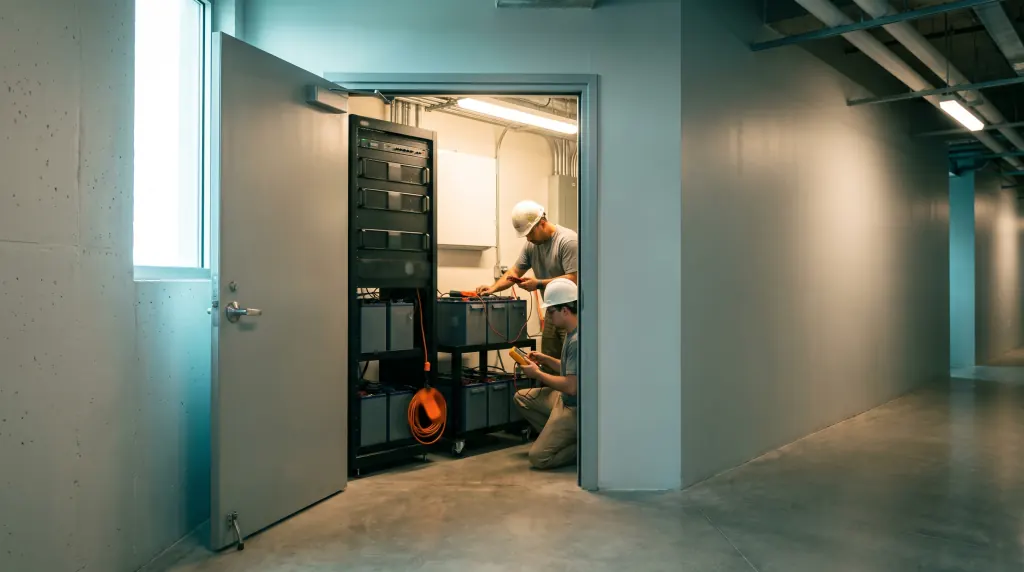
What happens. The tester compares amplifier gain with the acceptance values, checks every active component against the manufacturer's specifications and looks for oscillation with a spectrum analyzer.
What you do. Open the BDA and battery cabinets. Keep the room clear; it should not be used for storage.
Have ready
IFC 510.6.1 items 2 and 4; IFC 510.5.4 items 6 and 7
5. Grid walk
Test every floor
What happens. A grid coverage test on every floor, 20 areas per floor, with a calibrated radio through the agency's system.
What you do. Keep the escort moving ahead of the tester so no floor is skipped for lack of a key.
Have ready
IFC 510.6.1 item 1; IFC 510.5.4
6. Critical areas
The places firefighters work from
What happens. The fire command center, pump room, exit stairs, elevators, elevator lobbies and standpipe and valve locations are tested to their higher standard.
What you do. Make sure each of these is unlocked and reachable, including the elevator cars.
Have ready
NFPA 1225 18.8.3
7. Radio check
Signal checks on the public safety system
What happens. Every radio system your fire marshal lists has to work in the building. Some fire departments check it themselves; Miami-Dade, for example, tests both its 450 MHz fire and 800 MHz police systems.
What you do. Ask your fire marshal's office ahead of time whether it will attend or wants its own test.
Have ready
MDFR General Guidelines for BDAs (Miami-Dade)
8. Battery and alarms
Prove it runs on backup
What happens. Batteries and power supplies are tested under load for at least 1 hour, longer if the battery shows signs of failure. Trouble and supervisory signals are confirmed at the fire alarm panel and the annunciator.
What you do. Watch the fire alarm panel with the tester and note every signal that comes in.
Have ready
IFC 510.6.1 item 3; signals per NFPA 1225 18.14 (suggested check)
9. Report and sign-off
Close it out on paper
What happens. The test is documented and signed by the approved tester, and the report goes to the fire code official.
What you do. Get the full written report with results per floor, gain readings and the battery test. Any failure gets a written repair scope and a retest date. File it, and set the next reminder.
Have ready
NFPA 1225 20.3.10; IFC 510.6.1
Stage 5: The yearly cycle
After acceptance, the model code requires a test every year and after structural changes, with a report to the fire code official (IFC 510.6.1). In Florida the fire marshal may also require a new coverage assessment every 3 or 5 years at most, depending on the building (F.S. 633.202(18)(c)2); see the Florida re-test schedule. We have not found a separate five-year test in IFC 510 or the Florida statute. If your fire department requires one, the reminder can track a five-year date too. Miami-Dade also requires a service contract with a licensed radio service provider whose runner responds within four hours of a trouble signal (MDFR guidelines, quoting Sec. 14-69 of the county code).
- Paper you keep: each annual report, and the service contract.
- What trips buildings up: a battery that fails its load test, oscillation, and renovations. The failure finder covers each, and BDA testing explains the annual test.
Budget and quotes
The BDA cost guide lists what each stage costs, the cost per unit calculator splits a quote across the owners, and the fee estimator adds up published fire department fees. For an install, upgrade or repair, you can request quotes through ERRCSCheck. Your request goes to up to 3 vetted installers who serve your area. No texts and no cold calls.
Confirm every stage with your fire marshal (AHJ).
Free test reminder
Never miss the next BDA test
Add your building once and we email you before the next test is due. It is free, and setting a reminder never shares your details with an installer. Need a new system or a repair? Ask ERRCSCheck for up to 3 quotes.
Questions people ask
Who should be the single point of contact?
Pick one person, usually the property or facilities manager, and put that name on every request to the fire department, the radio agency and the vendor. The codes do not require it, but every stage below needs answers from the building, and keys, dates and documents go missing when three people answer.
Does the building or the vendor file the FCC registration?
The rule does not say. Class B boosters must be registered (47 CFR 90.219(d)(5)), and a new one before it operates (FCC DA 14-15). Agree in the contract who files, and keep a copy of the confirmation with the booster ID; fire departments ask for it.
How long does each stage take?
Few times are published. Miami-Dade emails pre-test results within two business days (MDFR guidelines), a Florida retrofit order gives at least one year from the notice (F.S. 633.202(18)(g)), and the test cycle is yearly (IFC 510.6.1). For design, approvals and installation, ask the vendor for a written schedule.
Sources
Primary documents we read for this page. Rules change; confirm with your fire marshal (AHJ).
- International Fire Code Section 510, Emergency Responder Communication Coverage, City of Eaton, Ohio (reproducing ICC model code text; edition not stated in the document)
- Florida Statutes 2026, section 633.202, subsection (18), The Florida Senate
- General Guidelines for the Deployment of Two-Way Radio Communication Enhancement System (BDAs), Miami-Dade County Fire Prevention Division
- 47 CFR 90.219, Use of signal boosters, Electronic Code of Federal Regulations
- DA 14-15: Wireless Telecommunications Bureau Announces Availability of Part 90 Class B Signal Booster Registration Tool (Jan. 7, 2014), Federal Communications Commission
- NFPA 1225, Standard for Emergency Services Communications, 2022 Edition: Chapter 18 and section 20.3.10, Georgia Office of Insurance and Safety Fire Commissioner (reproducing NFPA text)
- Implementing Order 04-123: Miami-Dade County Fire Prevention Fee Schedule (effective 10/01/2025), Miami-Dade County